Four Hours of Waiting for Four Minutes Inside: The Blue Grotto Day, Timed
The cave visit lasts about as long as it takes to read this paragraph twice. Everything else on a Blue Grotto day is boat, queue and island, and knowing the proportions in advance is the difference between a good day and a disappointed one.
In this guide
The proportion nobody expects
A Blue Grotto day from the mainland runs seven to nine hours. The time inside the cave is four to five minutes.
That ratio is not a criticism and it is not a scam. It is what a small sea cave with a metre-high entrance can physically offer, and the operators are working to the constraint rather than around it.
What it does mean is that the day has to be worth taking on its other merits — the crossing, the island, the swim stops, the coastline — because if the grotto is the only thing you value, you are buying four minutes for a hundred dollars and a day. Read the timeline below with that in mind.
The day, timed
A small-group boat day from Sorrento, with a morning departure, in reasonable conditions.
| Time | Where | How long | What is happening |
|---|---|---|---|
| 08:30 | Marina Piccola or the port | 20 min | Check-in, safety briefing, boarding |
| 08:50 | The crossing | 45–60 min | Sorrento to Capri; the bay opens out behind you |
| 09:50 | Around the island | 40 min | The Faraglioni, the sea arches and the caves |
| 10:30 | The Blue Grotto mouth | 20–60 min | Waiting your turn among the tenders |
| 11:00 | The rowboat transfer | 5 min | Four at a time, into a small wooden boat |
| 11:05 | Inside the cave | 4–5 min | The rower takes you round and back out |
| 11:15 | Back aboard | 10 min | Reassembly of the group |
| 11:30 | Swim stop | 45–60 min | Anchored somewhere sheltered; the best hour of the day |
| 12:30 | Marina Grande, or lunch aboard | 60–90 min | Free time on the island on many itineraries |
| 14:00 | More coast, or the return | 60 min | Depends on the listing |
| 15:30 | The crossing back | 45–60 min | Usually a livelier sea than the morning |
| 16:30 | Back at the port | — | Eight hours after check-in |
Add it up: five minutes in the cave, an hour waiting for them, and six or seven hours of Capri and the sea. That is the product.
The crossing
Forty-five minutes to an hour from Sorrento on a small boat, and it is a genuinely good hour.
Vesuvius sits behind you across the bay, the Sorrentine peninsula falls away, and Capri grows from a silhouette into cliffs. On a small-group boat you are outside rather than in a ferry cabin, which is most of the difference between this and the public hydrofoil.
Practical notes: sun is stronger on the water than it feels, spray is normal, and anybody prone to seasickness should take something before boarding rather than after the first swell.
Arriving at the cave mouth
The grotto is on the north-west coast, below cliffs, with no landing. Boats gather offshore and hold position.
The first thing you notice is how small and unremarkable the entrance is: a dark slot at the base of the rock, barely a metre high, that looks like nothing at all. The second is how many boats are waiting.
Your skipper will assess conditions here, and this is the moment the day is decided. If the swell is running into the entrance, nobody goes in, and there is no negotiating it — a rowboat and a metre of clearance do not tolerate waves.
What is the queue actually like?
Twenty minutes at ten in the morning; up to an hour by midday on a busy summer day.
Every visitor to this cave goes through the same entrance in the same small rowboats operated by the local rowers’ cooperative, four passengers at a time. That is a hard throughput limit, and the queue is simply arithmetic.
You spend it on the boat, offshore, in the sun. There is no shade, no landing and nowhere to go. This is the least comfortable part of the day and it is worth knowing about: a hat, water and sunscreen turn an hour of bobbing into something perfectly fine.
The transfer to the rowboat
Small wooden boats come alongside and take four passengers at a time, and the transfer between vessels in a moving sea is the part that surprises people.
It is quick, the rowers do it hundreds of times a day, and they will tell you exactly when to move. Anyone with mobility limitations should think carefully about this specific moment rather than about the cave — the transfer, not the cave, is the barrier.
Then you lie back. The entrance is low enough that everybody in the boat has to lie flat as the rower pulls on a chain fixed to the rock and times the swell. That takes about three seconds and it is the most memorable three seconds of the day.
The four minutes
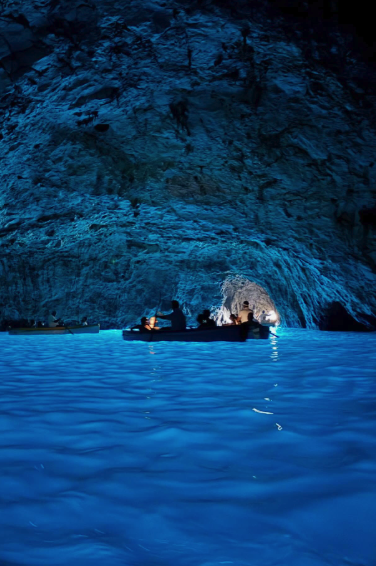
Inside, the cave opens into a chamber perhaps fifty metres long, and the water is lit an intense luminous blue from below.
The effect is real physics rather than lighting: sunlight enters through a much larger submerged opening beneath the visible entrance, the water filters out the red end of the spectrum, and what reaches the chamber is blue light coming up through the sea. Objects underwater take on a silver edge from the same effect.
The rower takes you in a slow circuit, usually says something about the cave, quite often sings, and brings you back out. Four to five minutes, and then the next boat is coming in.
Photography is difficult. The light is low, the boat is moving and the phone will not capture what your eye does. A short video works better than stills, and putting the phone down for at least half of it is advice everybody gives and few take.
What happens next
You transfer back to your boat, the group reassembles, and the day continues around the island. That transition is abrupt and it catches people: the thing you came for is over before eleven-thirty.
The good listings handle this by making the rest of the day genuinely good. The swim stop that follows is, for a lot of travellers, the part they describe when they get home, and the island circuit is spectacular in its own right.
The listings that handle it badly are the ones where the grotto is the only structured element and the remaining hours are unshaped. Reading the itinerary for what comes after the cave is more useful than reading it for the cave.
The rest of the island
What varies most between listings, and what actually determines the day.
- The Faraglioni. The three sea stacks off the south coast, with an arch you can pass through in a small boat. Almost every circuit includes them and they deserve the billing.
- The sea caves. The Green Grotto and the White Grotto among others, less famous and much less queued.
- Marina Grande and free time. Some listings drop you ashore for an hour or two; others stay afloat. The funicular to Capri town and the Piazzetta needs at least ninety minutes to be worth doing.
- Anacapri. On the fuller Naples-based itineraries, and a genuinely different place from Capri town — quieter, higher, with the chairlift to Monte Solaro.
An itinerary with two of those plus a swim stop is a full and satisfying day whether or not the cave opens.
The swim stops
Consistently the highest-rated part of these tours in the reviews, and the least advertised.
Boats anchor somewhere sheltered — often near the Faraglioni or in one of the small bays — and you swim off the back for forty-five minutes to an hour. The water around Capri is clear, deep and startlingly blue, and there is no queue for it.
Bring a towel and swimwear under your clothes. Some boats provide snorkelling gear and some do not, and it is worth checking the listing if that matters to you.
The crossing back
Forty-five minutes to an hour, usually with more sea than the morning had, and most of the boat is quiet.
The afternoon breeze in the Bay of Naples is a daily feature, so expect a livelier ride home than out. That is also the reason your morning departure mattered.
Plan a relaxed evening. Eight hours in the sun on the water is more tiring than it sounds, and Sorrento’s restaurants do not need booking weeks ahead.
So is it worth it?
The honest answer has two halves.
The cave itself, taken alone, is four minutes for the price of a day. If that is your only measure, the maths does not work and no listing will make it work.
The day, taken as a whole, is a boat around one of the most beautiful islands in the Mediterranean, an hour swimming in clear water, a circuit of sea stacks and caves, and four extraordinary minutes in the middle of it. On that measure it is one of the better days available on this coast.
Which is why the listings that do the rest of the day properly are worth more than the ones that treat the grotto as the whole product — and why a day where the cave turns out to be closed can still be a good one.
Common questions
How long do you spend inside the Blue Grotto?
How long is the queue at the Blue Grotto?
Do you have to lie down to get into the cave?
Can you take photographs inside?
What else does a Blue Grotto day include?
Is the Blue Grotto worth it?
Where to go next
- The fee, the rowers and your tour price — why you pay again at the cave mouth
- Closed by swell — what happens when the answer is no
- Which departure — the choice that sets your arrival time
- The grotto’s history — the Roman nymphaeum and the 1826 rediscovery
- Getting to Capri — ferries, the funicular and the Anacapri bus
- Compare Blue Grotto Capri Tours — every departure and format, side by side
Tours that fit this trip
Chosen to match what this guide covers, not for what sells.
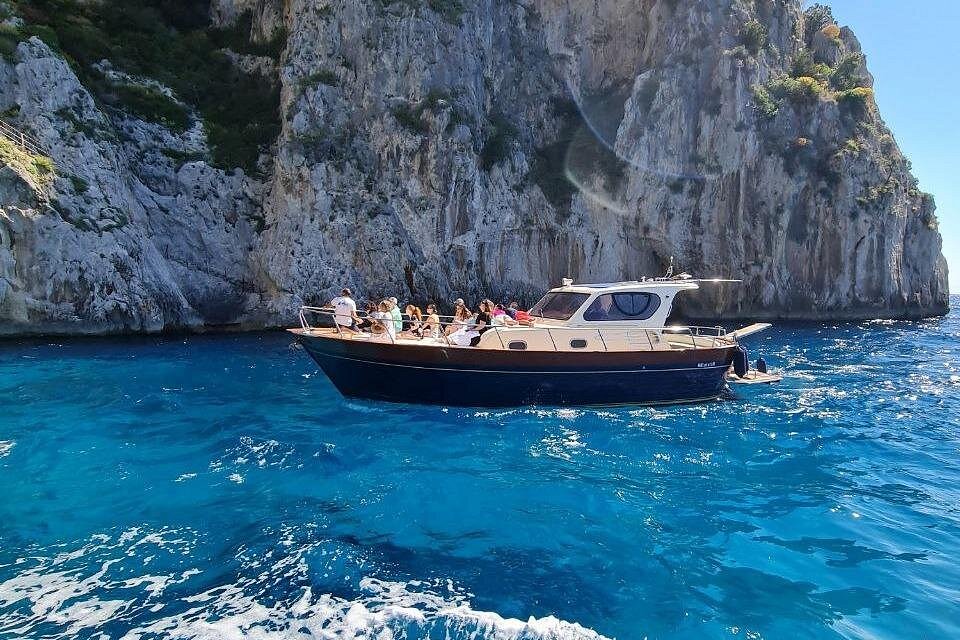
Sorrento: Capri Small-Group Boat Tour with Swim & 4 hour ashore
A day built around the swim stop as well as the cave — which, judging by the reviews, is what people actually remember.
From $116 per person
Check Availability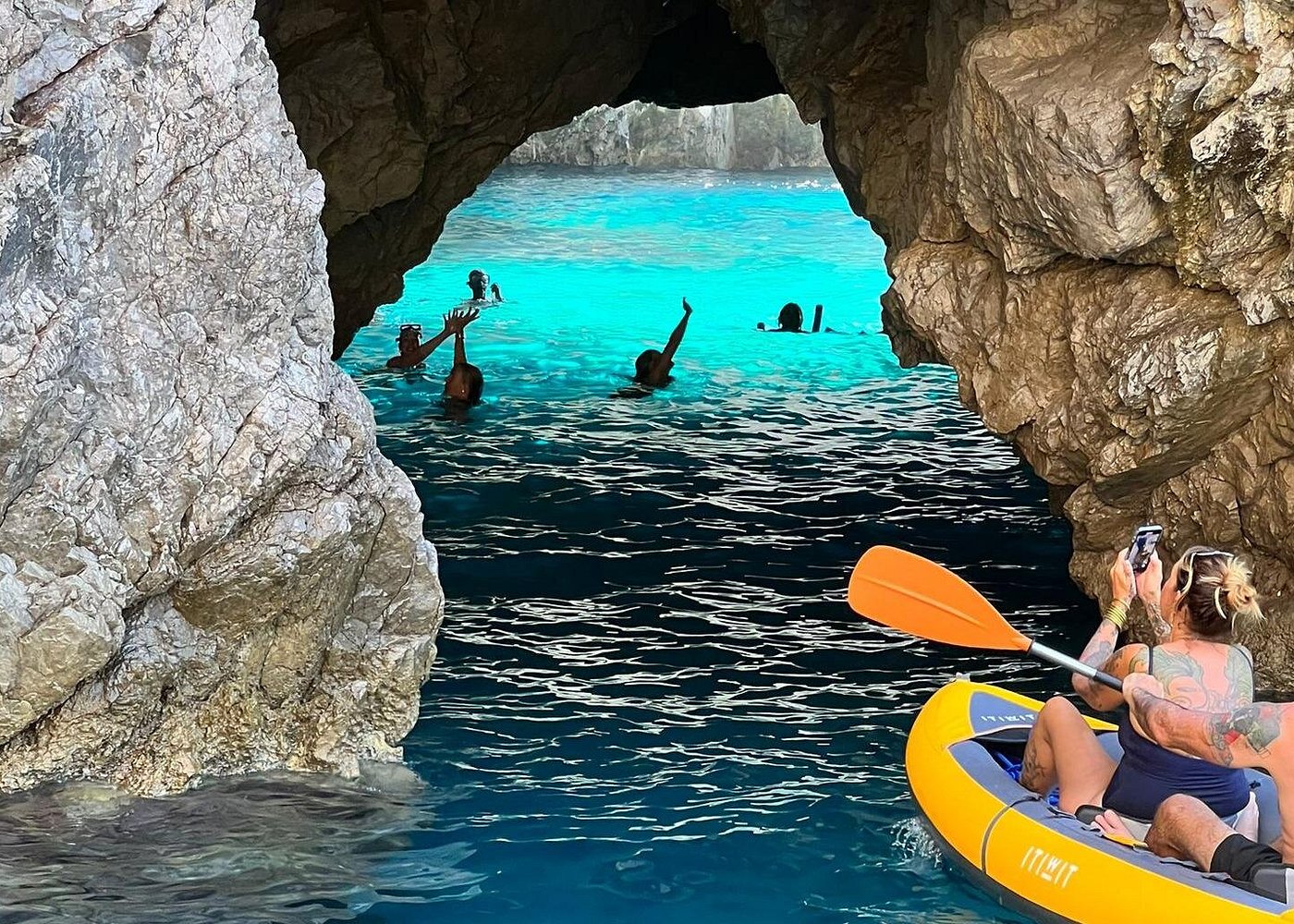
Blue Grotto Visit and Capri Semi-Private Boat Tour
A three-hour semi-private focused on the grotto itself, for readers who want the four minutes without the eight hours.
From $198 per person
Check Availability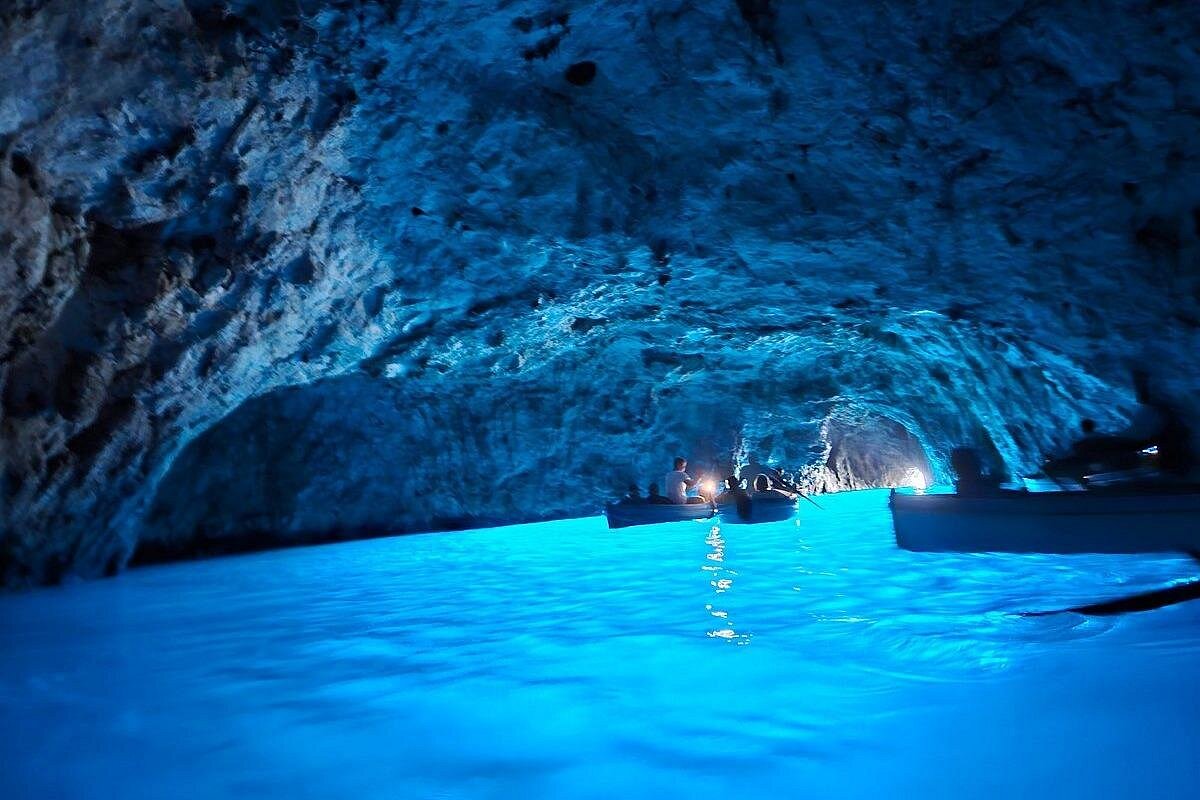
Full-Day Capri, Anacapri and Blue Grotto Tour from Sorrento
The fuller island day including Anacapri, so the hours after the cave are structured rather than left over.
From $184 per person
Check Availability